
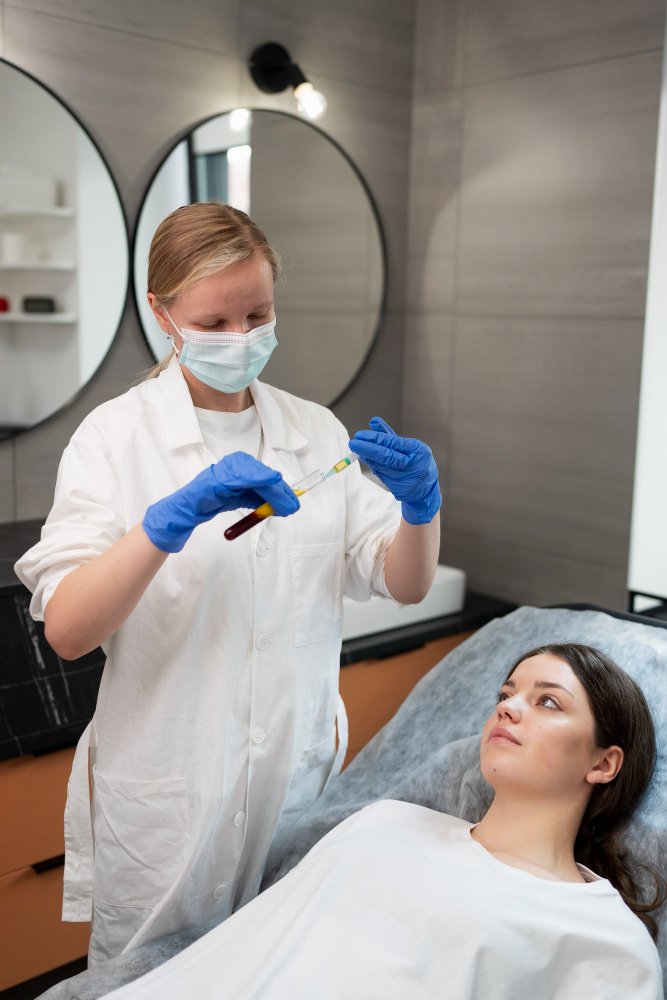
Ashley Atkins, MSN, APRN, FNP-C
Ashley Atkins works directly with patients throughout the consultation and follow-up process.
Peptide therapy is not one standard program for every patient. Different peptide medications have different purposes, evidence, risks, and regulatory status.
Our Florida telehealth practice provides personalized consultations for adults who want to learn whether an available peptide therapy may be medically appropriate.
Your care begins with a conversation about your health history, current medications, previous experiences, questions, and personal goals.
Online conversations about peptides often make them sound simple. In reality, each product must be evaluated individually.
Ashley Atkins works directly with patients to understand their questions, health history, previous experiences, and goals. She is supported by Dr. Jon Kimball and Dr. Paige Lindberg, a husband-and-wife physician team.
Together, our providers help patients understand what is known about an available therapy, what limitations may apply, and whether it should be considered.
We do not operate an open online peptide store. New patients cannot select and purchase prescription products without an appropriate consultation and medical review.
What would you like to better understand or discuss with a provider?
What health conditions, procedures, or previous therapies should your provider consider?
Could a medication, supplement, or existing therapy affect your eligibility?
Would blood work or another type of testing provide useful information?
Is the product FDA-approved or compounded, and where would it be prepared or dispensed?
Do the available evidence, potential risks, and your individual circumstances support considering therapy?
No single factor determines whether peptide therapy is appropriate. Your provider considers the complete picture before recommending a plan.
Peptides are short chains of amino acids. Amino acids are often described as the building blocks of proteins.
Some peptides occur naturally in the body and help carry messages between cells. Peptide-based medications may be developed to act on specific biological processes.
The word “peptide” describes a broad category. It does not mean that every peptide works the same way, has the same evidence, or carries the same risks.
A product should be evaluated based on the specific substance, its intended use, its source, available evidence, and the patient considering it.
Peptide therapy refers to the medically supervised use of a specific peptide-based product for an appropriate clinical reason.
There is no single peptide therapy that is right for every patient.
Some peptide medications are FDA-approved for specific uses. Other products discussed online may be compounded or may not have FDA approval for the way they are being promoted.
That distinction matters.
FDA-approved medications are reviewed for safety, effectiveness, and manufacturing quality for their approved uses. Compounded medications are not FDA-approved, which means the FDA does not review them for safety, effectiveness, or quality before they are marketed.
Before considering a therapy, your provider should explain:
What the product is
Why it may be considered
Whether it is FDA-approved or compounded
What is known about its potential benefits
Important limitations in the available evidence
Possible risks and side effects
Where the medication would come from
What follow-up may be needed
The status of a product does not tell a provider whether it is right for a particular patient. It does help patients understand how the product has been evaluated and what questions they should ask.
Compounding may serve an individual patient need in appropriate circumstances, but compounded medications are not the same as FDA-approved products.
Patients may request a peptide therapy consultation for different reasons.
Having an interest in a particular product does not mean that it is safe, available, or medically appropriate for you.
Your initial consultation gives you an opportunity to ask questions and receive guidance based on your individual health information.
Your care begins with an individual medical review. During your consultation, your provider may ask about:
Your provider may also discuss whether another therapy, medical evaluation, or service would be more appropriate.
The goal is not to place every patient on a peptide. The goal is to help each patient understand the safest and most appropriate next step.
Your provider may order laboratory testing when it is medically appropriate.
The need for testing depends on your medical history, current health, and the specific therapy being considered. There is no single laboratory panel that is right for every peptide or every patient.
When blood work is ordered, you will receive a laboratory requisition that can be taken to an approved laboratory, such as Labcorp or another registered laboratory.
A licensed provider will review your results and consider them alongside your medical history, medications, concerns, and goals.
Laboratory results alone do not determine whether peptide therapy is appropriate
The therapies available through Restore MD depend on current medical guidance, product availability, pharmacy relationships, and the individual patient’s needs.
Your provider will discuss only the options that are currently offered by the practice and may be medically appropriate for you.
For every product discussed, you should receive clear information about:
The name of the product
Why it may be considered
Whether it is FDA-approved or compounded
The intended use
The limits of the available evidence
Potential risks and side effects
The pharmacy or dispensing source
Follow-up and monitoring
No. Peptide therapy is not appropriate for every patient. The possible benefits, risks, side effects, and monitoring needs depend on the specific product and the individual patient. Before recommending an available therapy, your provider may consider:
Your personal medical history
Current medical conditions
Current medications and supplements
Allergies
Pregnancy or breastfeeding
Previous reactions to medications
Laboratory results
The intended use
The quality and source of the product
Available safety information
Your ability to complete appropriate follow-up care
Your provider may decide that another option or medical evaluation would be more appropriate. Eligibility and results vary by patient. No particular outcome can be guaranteed.
Tell us what you would like to discuss and provide your contact information.
Speak with a provider about your medical history, medications, questions, and goals.
Your provider may order blood work or other medically appropriate testing.
A licensed provider reviews your available results and complete medical information.
Your provider explains whether an available peptide therapy or another service may be appropriate.
Your plan may include follow-up consultations, laboratory monitoring, and medication reviews.
Our telehealth model allows eligible patients throughout Florida to speak with a licensed medical provider without making frequent trips to an office.
Laboratory testing may still need to be completed at an approved laboratory when medically appropriate. The practice currently serves patients located in Florida. Practitioners must hold the appropriate
Florida license or telehealth registration to provide care to Florida patients.
Ashley Atkins is the primary patient-facing provider. She works with Dr. Jon Kimball and Dr. Paige Lindberg to support thoughtful medical care.
Recommendations are based on the patient, not an automated product menu.
Patients should understand whether a product is FDA-approved or compounded and where it will be prepared or dispensed.
We discuss what is known, what remains uncertain, and what questions are important for the specific therapy being considered.
Our practice provides convenient telehealth consultations for eligible patients located throughout Florida.
When therapy is prescribed, follow-up may include virtual appointments, laboratory testing, medication reviews, and appropriate adjustments.
Start with a personalized consultation and take the next step with a qualified medical team.
Ashley Atkins works directly with patients throughout the consultation and follow-up process.
Dr. Jon Kimball supports the practice as part of the medical team.
Dr. Jon Kimball is a Board Certified Orthopedic and Spine Surgeon who specializes in the treatment of patients suffering from chronic pain.
Dr. Paige Lindberg works alongside Dr. Jon Kimball as part of the practice’s husband-and-wife physician team.
Peptides are short chains of amino acids. Some naturally occurring peptides act as messengers in the body, while certain peptide-based substances have been developed or compounded for medical use.
No. Peptide therapy is a broad term that may refer to different substances with different actions, evidence, risks, and regulatory status.
Each product must be evaluated individually.
No. Some peptide-based medications are FDA-approved for particular uses, while other products may be compounded or unapproved.
Your provider should explain the status of the specific product being discussed.
A compounded peptide medication is prepared by a compounding pharmacy based on a prescription for an individual patient.
Compounded medications are not FDA-approved and are not reviewed by the FDA for safety, effectiveness, or quality before marketing.
No. A compounded product should not automatically be described as a generic or equivalent version of an FDA-approved medication.
Patients should be told clearly when a product is compounded.
A licensed provider must review your health history, current medications, concerns, goals, and other relevant information.
Laboratory testing may also be recommended.
Possibly. The need for blood work depends on the patient and the specific therapy being considered.
Your provider will determine which tests, if any, may be appropriate.
Eligible patients located in Florida may be able to complete consultations and appropriate follow-up appointments through telehealth.
Laboratory testing may still be required at an approved laboratory.
The source depends on the specific medication being prescribed.
Before beginning therapy, patients should receive clear information about the dispensing or compounding pharmacy and whether the medication is FDA-approved or compounded.
No. New patients must complete an appropriate consultation and medical review before prescription therapy can be considered.
The patient portal is intended for established patients managing eligible refills, reorders, records, or practice communications.
Ashley Atkins is the primary patient-facing provider. She is supported by Dr. Jon Kimball and Dr. Paige Lindberg, a husband-and-wife physician team.
The practice provides telehealth consultations for eligible patients located in Florida.
Provider licensing and the medical appropriateness of telehealth will determine whether a particular service can be provided.
Begin by requesting an initial consultation. Our team will review your request and explain the next appropriate step.
You may have questions about a particular product, or you may simply want to understand whether peptide therapy is worth discussing.
Your initial consultation gives you an opportunity to speak with a licensed provider about your health, medications, previous experiences, and goals.
When medically appropriate, your provider will explain the available options and help determine the most appropriate next step.